
Borosilicate or Soda Glass or Plastic Labware: Which Does Your Lab Need?
Glassware · 12 September 2026
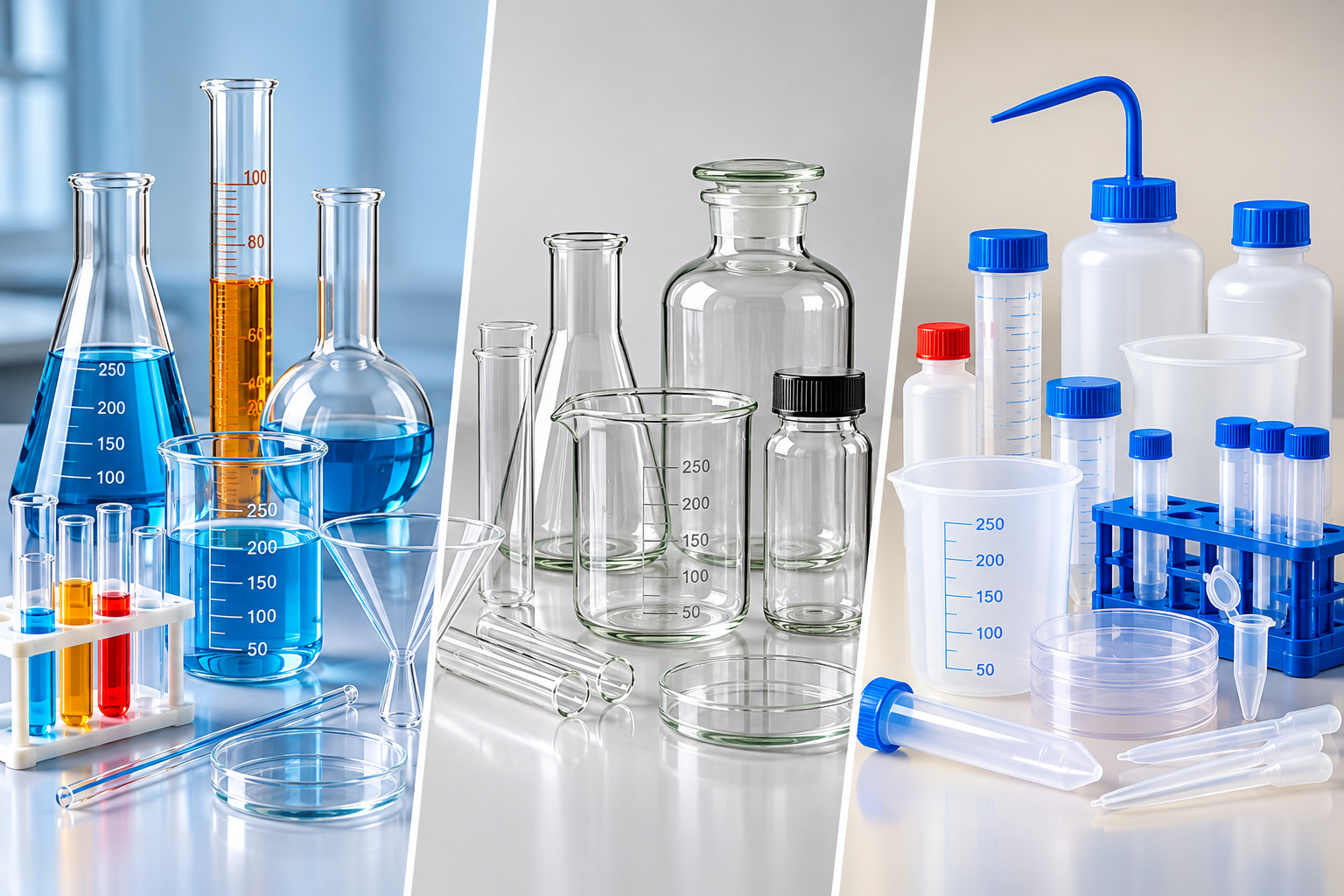
Choosing the right laboratory ware is important for safety, accuracy, durability, and cost. Borosilicate glass, soda-lime glass, and plastic labware each have different properties and are suited to different laboratory applications.
1. Borosilicate Glass — For Heat & Chemical Work
Borosilicate glass is the preferred choice for laboratory work involving heating, temperature changes, and many chemical reactions. It has good thermal resistance and good chemical durability.
Common Uses
Borosilicate glassware is commonly used for:
- Beakers
- Conical flasks
- Round-bottom flasks
- Test tubes
- Boiling tubes
- Measuring cylinders
- Reagent bottles
- Funnels
- Dropping bottles
- Distillation and reaction apparatus
- Laboratory tubing and specialized glass assemblies
It is particularly useful when glassware needs to be heated directly or exposed to significant temperature changes.
Best for: Heating, chemical reactions, preparation of solutions, distillation, and general laboratory experiments.
2. Soda-Lime Glass — For General, Non-Heating Applications
Soda-lime glass is economical and suitable for many routine laboratory applications where high thermal resistance is not required.
Common Uses
It can be found in applications such as:
- General-purpose bottles
- Simple storage containers
- Some test tubes
- Pipettes and droppers
- Petri dishes
- Slides and coverslips
- General laboratory containers
However, soda-lime glass has lower thermal-shock resistance than borosilicate glass. It should therefore not normally be used for direct heating or sudden temperature changes unless the particular product is specifically designed for that purpose.
Best for: Routine handling, storage, observation, and applications where heating is not involved.
3. Plastic Labware — For Safety, Flexibility & Everyday Handling
Plastic laboratory products are lightweight, generally resistant to breakage, and available in many forms. Different plastics have different chemical and temperature resistance, so the material should always be checked before use.
Common Uses
Plastic labware is widely used for:
- Wash bottles
- Sample containers
- Reagent bottles
- Storage bottles
- Measuring cylinders
- Pipettes and transfer pipettes
- Funnels
- Microcentrifuge tubes
- Centrifuge tubes
- Petri dishes
- Disposable laboratory consumables
- Waste containers
Plastic is particularly useful where breakage is a concern, such as student laboratories, field work, sample transportation, and routine handling.
Best for: Storage, sample handling, dispensing, disposable applications, and situations where lightweight or shatter-resistant equipment is preferred.
Quick Comparison
| Feature | Borosilicate Glass | Soda-Lime Glass | Plastic |
|---|---|---|---|
| Heat resistance | ⭐⭐⭐⭐⭐ | ⭐⭐ | Depends on polymer |
| Thermal-shock resistance | Excellent | Limited | Generally not suitable for high heat |
| Chemical resistance | Excellent for many applications | Good for many routine uses | Depends on plastic type |
| Breakage resistance | Moderate | Moderate | High |
| Weight | Heavy | Heavy | Lightweight |
| Heating experiments | Recommended | Generally avoid | Generally avoid |
| Storage | Excellent | Good | Excellent |
| Disposable use | No | Sometimes | Common |
Precautions & Care
Borosilicate Glass
- Check for cracks, chips, or scratches before use.
- Avoid sudden temperature changes whenever possible.
- Do not place hot glassware directly on a cold or wet surface.
- Use appropriate heat-resistant equipment when handling hot glass.
- Never force glass tubing into stoppers; lubricate and handle carefully.
- Allow heated glassware to cool before washing.
Soda-Lime Glass
- Do not expose ordinary soda-lime glassware to sudden heating or cooling.
- Do not use it for high-temperature experiments unless the manufacturer specifically permits it.
- Inspect regularly for cracks and chips.
- Handle carefully because damaged glass can break unexpectedly.
Plastic Labware
- Check the plastic type and chemical compatibility before using it with solvents or aggressive chemicals.
- Keep plastics away from flames and excessive heat unless specifically designed for high-temperature use.
- Do not use damaged, cracked, or badly deformed containers.
- Avoid storing chemicals in plastic containers for longer periods unless the container is suitable for that chemical.
- Clean reusable plasticware according to the manufacturer's recommendations.
Which One Should Your Lab Choose?
There is no single material that is best for every laboratory.
Choose borosilicate glass when you need heat resistance, thermal-shock resistance, and durable laboratory glassware for chemical and physics experiments.
Choose soda-lime glass for economical, general-purpose applications where heating and rapid temperature changes are not involved.
Choose plastic labware when lightweight, shatter-resistant, disposable, or convenient equipment is more important than high-temperature performance.
Short Summary
Borosilicate = Heat & demanding laboratory work
Soda-lime = Economical general-purpose glassware
Plastic = Lightweight, shatter-resistant everyday labware
The best laboratory setup often uses all three materials, selecting each according to the experiment, chemical compatibility, temperature, and safety requirements.