
Glassware (Borosilicate Glass)

AIR CONDENSERS – BOROSILICATE GLASS

Product code: SMC-2010 HSN: 7017

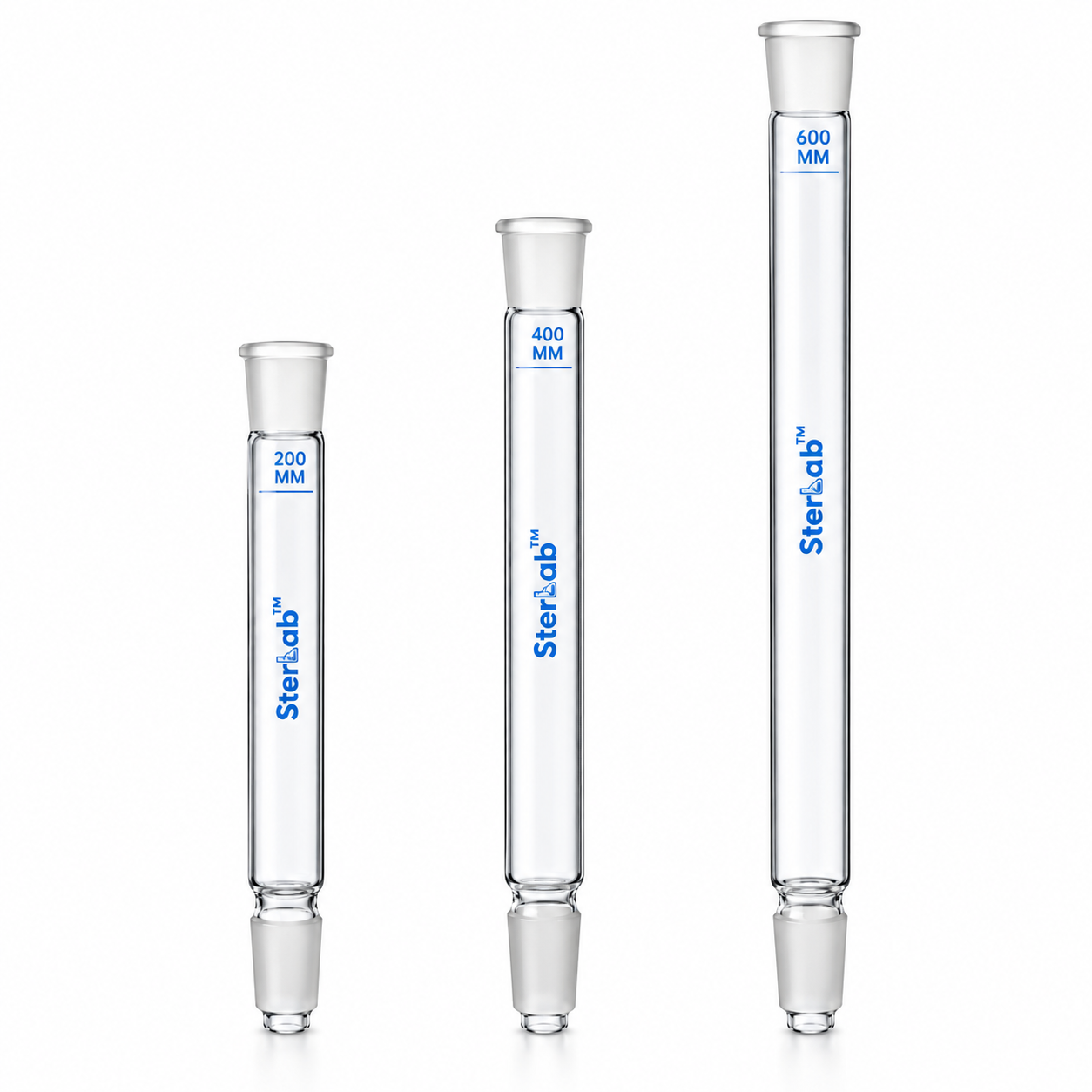
Air Condensers, manufactured from borosilicate glass, are laboratory glassware designed for use in distillation and other suitable heating processes where vapours require cooling and condensation. They facilitate heat transfer from hot vapours to the surrounding air, allowing the vapours to condense as they pass through the condenser. Available in multiple lengths and joint configurations, these condensers are suitable for educational, research, and routine laboratory applications.

Item codeSize / descriptionQty
SMC-2010/1 B14 · B14 · 200 MM
SMC-2010/2 B19 · B19 · 200 MM
SMC-2010/3 B24 · B24 · 250 MM
SMC-2010/4 B19 · B19 · 400 MM
SMC-2010/5 B24 · B24 · 500 MM
SMC-2010/6 B34 · B34 · 500 MM
SMC-2010/7 B19 · B19 · 600 MM
SMC-2010/8 B24 · B24 · 750 MM
SMC-2010/9 — · B19 · 750 MM
SMC-2010/10 — · B24 · 750 MM
SMC-2010/11 — · B19 · 1000 MM
SMC-2010/12 — · B24 · 1000 MM

Enter the quantity next to each size you need (0 = not needed), then add them all in one go.

    • Made in our Ambala facility
    • Export packing & documents
    • Custom sizes on request
    Borosilicate Glassware catalogueFull specifications and item codes Download

    Description

    SterLab™ Air Condensers are manufactured from borosilicate glass and designed for laboratory procedures involving the condensation of vapours through natural air cooling.

    During operation, hot vapours pass through the condenser tube and lose heat to the surrounding air. This cooling process helps convert vapours into liquid, depending on the vapour properties and operating conditions. Unlike water-cooled condensers, air condensers do not require a cooling-water connection, making them suitable for applications where air cooling is appropriate.

    The range includes different condenser lengths and interchangeable ground-glass joint configurations, providing options for assembly with compatible laboratory apparatus. Certain models are specified with both socket and cone joints, while others are listed with a cone joint only, as detailed below.

    These air condensers are suitable for chemistry laboratories, educational institutions, research facilities, and other laboratory environments requiring appropriate air-cooled condensation.

    SPECIFICATIONS

    • Product Name: Air Condensers

    • Catalogue Number: SMC-2010 Series

    • Material: Borosilicate Glass

    • Cooling Method: Natural Air Cooling

    • Function: Condensation of vapours

    • Joint Type: Ground-Glass Socket and/or Cone, depending on model

    • Available Lengths: 200 MM to 1000 MM

    • Applications: Distillation, reflux arrangements where suitable, and other compatible laboratory processes

    AVAILABLE SIZES / MODELS

    Catalogue NumberSocket JointCone JointLength
    SMC-2010/1B14B14200 MM
    SMC-2010/2B19B19200 MM
    SMC-2010/3B24B24250 MM
    SMC-2010/4B19B19400 MM
    SMC-2010/5B24B24500 MM
    SMC-2010/6B34B34500 MM
    SMC-2010/7B19B19600 MM
    SMC-2010/8B24B24750 MM
    SMC-2010/9—B19750 MM
    SMC-2010/10—B24750 MM
    SMC-2010/11—B191000 MM
    SMC-2010/12—B241000 MM

    KEY FEATURES

    • Borosilicate Glass Construction: Suitable for a range of routine laboratory applications.

    • Air-Cooling Design: Condenses suitable vapours without a cooling-water connection.

    • Multiple Length Options: Available in lengths from 200 MM to 1000 MM.

    • Ground-Glass Joint Options: Different socket and cone sizes support compatibility with corresponding apparatus.

    • Versatile Laboratory Applications: Suitable for appropriate distillation and other vapour-condensation procedures.

    NOTES

    • Joint sizes: B14, B19, B24, and B34 are reproduced from the supplied specifications. Confirm the applicable joint standard and dimensions before ordering.

    • Models SMC-2010/9 to SMC-2010/12 are listed with cone joints only, as specified in the supplied table.

    • Air condensers are most suitable where natural air cooling provides sufficient condensation. For high vapour loads or vapours requiring more intensive cooling, a water-cooled condenser may be more appropriate.

    • Confirm the condenser's suitability for the chemicals, temperatures, and apparatus configuration involved in the intended procedure.

    • Inspect the glassware and ground joints for damage before use.